Monday, January 16, 2017

Baritone neck

Unrelated: guinea pigs perfecting hover technology.
DC Kunkle has advise for attaching guitar necks. This is specifically the instructions for his baritone neck:


Long scale conversion neck for the Tele style body with no modification necessary for intonation, I start with the 25.5" scale and moved it out two more frets to achieve the 28.629" scale. There's a 10-15 business day build/handling time on these. I try to keep it to 10 but when it gets real busy, it can sometimes take a little longer.
My standard Specs for this neck are as follows:
·        28.629" scale.
·        one  piece Eastern Hard Rock Maple (a standard for bolt on necks)
·        single action truss rod
·        black walnut skunk stripe
·          T  style peg head with stepped tuner holes to accommodate the die cast Schaller/Gotoh style tuners. The big hole diameter is 13/32" =.404" =10.26mm The upper small hole diameter is 21/64" = .325" = 8.28mm
·        T style heel
·         1 & 11/16th  ” at Nut
·        2 3/16th  ” at Heel
·        14" radius Hard Maple fret board
·        1/8th “ flat bottom nut slot, (nut not included)  if you would like a nut, see extras
·        23 frets
     Comes with no mounting holes (see extras)
11  .110" wide, .053" tall frets installed,     I spray two coats of lacquer on the fret board. If you plan to add more lacquer I will sand with 320 dry then buff slightly with fine scotch guard then install the frets. This makes it easy to add more lacquer if you choose to do so. Let me know at time of purchase if you would like me to do that. When I do add more lacquer after the frets are installed, I take and cut masking tape into thin strips by laying it on a peace of glass and using a straight edge and utility knife blade. ( I usually use 12" to 16" strips) You can tailor the width of the strips to best cover the tops of the frets but letting the lacquer bridge the fret board and bottom edge of the frets.   - no fret work. (see extras)
·        7/32" black position marker dots
·        3/32" black side dots
·        standard back cut is vintage U, similar to a 54 T/S round back or a 59 L/P round back, .875" at the first fret, .975" at the twelfth fret.
      EXTRAS    If you choose to have any extras  done you can commit to buy but don't pay, send a message with which extras you would like and I will send an invoice  for the correct amount.
     Fret work.     I can do a fret mill (level) crown and polish the frets for you as an option for an extra $25, if you do not have the experience to do this yourself, this option comes highly recommended. 
     Bone nut.      For an extra $25. I can rough in a bone nut cut in with nut files and left a little high (factory) left loose so you or your tech can tailor it to your own taste. To secure when your ready just put a dab of wood glue on the outside bottom  two edges, install on neck and tighten the strings, the outside two strings is all you need to tighten, let sit for a hour or so and your good to go. You can put all the glue you want to glue this on, but the more you put on the harder it is to replace later on.
      Drill mounting holes.    For an extra $5. I can drill those for you.
     The neck comes with two coats of nitrocellulose lacquer, not meant to be perfect, but it's a good hard finish that will let you put your project together with out the hassle of doing finish work yourself.

Friday, December 16, 2016

Fish Bass

Designing an ergonomic bass. The thing I don't dig so much about the bass in that article is that it's designed for your right hand to sit in the middle of the bass. And my interest is in playing near the bridge more comfortably.
Huh. In the early 70's Fender moved the bridge pickup somewhat closer to the bridge.
I found a piece of old pine in the dumpster behind my apartment building. I thought it would be funny to make, instead of a "tonewood" guitar, a trashwood one.
This graphic is relevant to my needs.

Allen Eden guitar neck. Pre-cut bone nut. Massive blank headstock. I need an 11/16 drill bit for the tuner holes.

Sunday, December 11, 2016

Make a bass drum

So I've had this idea, after seeing the Turangaleela at the New York Philharmonic earlier this year and also having seen the Kachanov Singers, that the orchestral bass drum is actually the most expressive drum there is.
And honestly I'm not getting a lot of push-back from drummers on this idea. The drum can be quiet and round. It can make delightful little "canks." It can be muted, it can be resonant, it can be sharp, it can be LOUD. I mean freaking LOUD.

And if you're going to have a concert bass drum, it should be 40" by 20" deep.
Thing is, they cost around $2700.  Also note, though, one of the big tricks is that those come with a sweet stand which completely suspends the drum and lets you tilt it at any angle you want. Which kind of rocks.
But let's experiment with the mind for a while, shall we? Mind. Experiment.

There are some resources on the interwebs for building one's own drums. Thing is the pre-built easily-available drum shells don't get as big as 40".
But there's another way -- building a drum with staves instead of a bent shell.

Stave calculator by Uniontown Labs. It's cool but it doesn't actually go up to 40". And you know you need a 40-inch concert bass drum. But still, it does a lot of the calculations (even if there's a seeming limit in the numbers somewhere which make it output "infinity" in some fields.)

But. Again. Decimal inches? I ain't got time for that. I mean unless we really started making decimal inch rules. Which. I mean I guess I have to be able to find one. But. Ugh. Millimeters. I'd so prefer to work in millimeters.

Decimal InchesFraction InchesCentimeters
Rough Diameter42.1250"42 1/8"107.00cm
Finished Diameter41.8750"41 7/8"106.36cm
Shell Depth22.00"22"55.88cm
Number of Staves20
Joint Angle18.00°
Bevel Angle9.00°
Stave Outer Width6.672"6 11/16"16.95cm
Stave Inner Width6.434"6 7/16"16.34cm
Stave Thickness0.750"3/4"1.91cm
Rounded Thickness0.369"3/8"0.94cm
Board Length Required800"Infinity"Infinitycm
Staves per Width1
Staves per Length20
Board Feet RequiredInfinity'
Cost Per Shell$Infinity

Saturday, December 10, 2016

Trashcaster

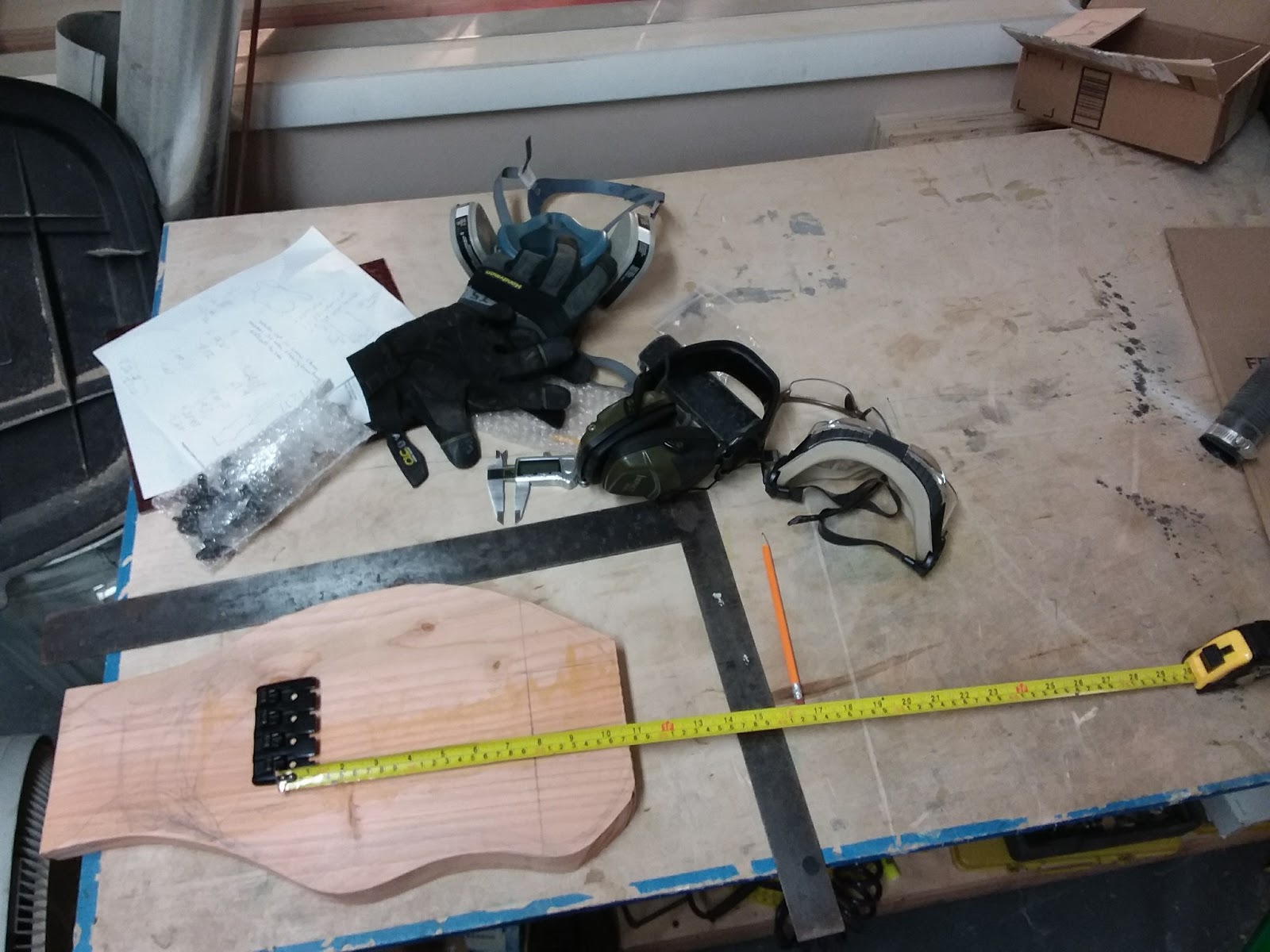
Among thing I am doing in my copious spare time is building a short-scale (30") bass guitar.

Not on purpose but it turns out I'm making a guitar that kind of looks like a fish.
It starts with a piece of wood I pulled out of the dumpster behind my building. I went to FabLab and planed it (the jointer there ain't working because it has an unusual 220v plug so it doesn't go into the socket. I really wish it only had a 110v motor -- or its own transformer. Ugh. I don't want to play with 220, but I'm an American, more on that later) and the piece of wood seems to be a piece of pine.
I thought that instead of making the bass out of "tonewood" I would make it out of "trash wood" and therefore the instrument would be a
Trashwood Guitar
Which amuses me but I don't know how that's going to turn out. I have this idea that the contours of the body will encourage playing near the bridge. Furthermore I (perhaps mistakenly) think this is a good thing.

I so wish we could just use the metric system here. Unfortunately all the rules at the Lab are Imperial and so all the detail work needs to be done Imperial. But adding and subtracting 9/32 of an inch from 4.183" (yes, we flop back and forth into decimal inches) is just too much for my little brain. I mean come on, if we're going to use decimal inches can we puhleeze just use millimeters?
Sigh.

Anyway, I get to go on a journey of discovery where I learn how to rout a Strat-style neck pocket. Also I have to figure out if the wiring all goes under a pickguard or if I rout from the back of the bass so that little holes poke up through the wood for the volume controls and jack. I dunno.

Two humbucking pickups. And they should be at 25.25" and 27" from the nut. Just like Ethan says.
I'll be experimenting with the MM 4 string bass humbucker by Warman in the neck position. The website says it is "Overall size, excluding the 3 mount holes is 90mm x 48mm and 20mm overall depth."
And the bridge position will be their Jazzbar.
So 25.25" is 641.35mm. That's where the neck pickup wants to be.
The bridge pickup wants to be at 685.8mm.
We will round these numbers off.
The neck is 762mm scale.

The ideal neck pickup position is therefore 121mm from the bridge.
The idea bridge pickup position is  76 mm from the bridge.

My calculations show they will just barely fit.

Wednesday, November 30, 2016

EB0 2 pickup demo


It's all good times. New pickups in the EB0.

I wired the guitar like a Jazz bass but without a tone control.
I routed freehand without any damage to the finish. I went to drill the hole for the wire from the pickup to the volume pot and I punched a small hole all the way through to the back of the guitar. I'm not showing you that.
Conclusions? The position of 25.25" from the nut on a short-scale bass is the best "neck" position. Putting another pickup even closer to the bridge will get more of that midrange honk the kids love so much these days.

Bassic Testing

I made a little rig. I swept a DiMarzio One pickup across the strings of an Epiphone EB0 bass. I learned things.

I learned mostly that Ethan was right about the pickup location.

Conclusions? Best pickup positions on short-scale bass are at: 25.25" from nut and 26.75" (or 27")from nut.

Tuesday, November 29, 2016

Putting pickups on basses

Following is an email (between the "§§§'s") with Ethan regarding the positioning of pickups on short-scale basses.
§§§
Well, I did some thinking and I did some measuring.  Many people feel that the "sweet spot" for a 34" scale bass is where a standard P-bass pickup resides, which is 28.6" (or close enough) from the nut.

First I did some measuring to see if all my P-basses were the same, and they were.  Then I measured some other, non-fender basses to see where they put their neck pickups and, sure enough, they were pretty damn close to 28.6" - G&L, Modulus, Kawai, all 28.6".  One exception was Musicman, who puts the neck pickup on the Sabre closer to the neck, but I never cared much for the neck pickup sound on a Sabre, which leads me to believe that this 28.6" may be something like a right answer.

As it happens, the original, single-coil P-bass places the pickup an inch closer to the neck.  It sounds good there, but it's a very bright sounding single-coil - very UNlike a split P.  Did Leo Fender move it closer to the bridge when he switched to the split P humbucker to reduce the muddiness of the newer, quieter pickup?  Yeah...  probably.  Did he come up with the new measurement scientifically?  Almost definitely not.  Did he just get lucky?  I doubt it.  I'll bet he just tried it in a bunch of places and chose whichever he liked best.

The Jazz Bass, which came later than both versions of the P-bass splits the difference at just over 28", but the pickup splits the difference, too: single coil, but not as bright sounding as a SC P-bass pickup.  I somehow doubt this is all a coincidence.

So, where does that leave you?  Well, a 30" scale length is about .882 of a 34" scale length, so the numbers on a 30"-scale bass would play as follows:
SC P-bass: 24.25"
Jazz Bass:  24.9"
Std P-bass  25.25"

Incidentally, 25.25" happens to be exactly where the pickup is on my vintage Dan Armstrong/Danelectro, which is the only short-scale (30") bass I own, and it sounds really good there.  There's a bass with the same scale as yours and the pickup is placed right where an equivalently-scaled P-bass' pickup would be.  That's a "lipstick-tube" pickup on there, which is an overwound single-coil that sounds like the bastard child of a split P-bass pickup and a P-90.

So in your position, I would probably choose 25.25" from the nut (to the center of the pickup) if I were using a humbucker of any kind (including a split P), 24.9" for a J pickup or any other bass pickup with a bit more clarity (like the newer, full-range Bartolinis, Nordstrand singles, Delanos or lower-output EMGs) and leave the 24.25" position alone, as it's probably not far enough from where your pickup is now to make any substantial difference.

As far as a bridge pickup goes, Gibson tended to put them too close to the bridge.  I guess they thought they'd only be used as an addition to the neck pickup.  I'd suggest putting it right between the other pickup and the bridge or maybe even a little closer to the other pickup.  There will be less difference between the two pickups, true, but there will still be a difference and what you'll gain is two, distinct sounds that can both be used as stand-alone bass sounds - something you really can't do with a stock Gibson bridge pickup.

Now, just to muddy the waters a little further (because I can), the Musicman Stingray only has one pickup - ostensibly a "bridge" pickup, although it's far enough from the bridge to still sound like a [neck] pickup.  It sits at 30.6", which equates to 27" on a 30"-scale bass.  A Rickenbacker's neck pickup is really close to the neck and most people use the bridge pickup as the main pickup on a Ric.  Translated to 30" scale from a Ric's 33" the pickup would sit at 26.8".  In other words, if the scales were equal, a Ric's bridge pickup sits VERY near where a Stingray's pickup is, which explains their similar growl.

Jazz basses and G&Ls place the bridge pickup closer to the bridge, just on the edge of usefulness as a standalone pickup, IMO.  They sit at 31.5 or 32", depending upon the year.  That equates to 27.8" or 28.2", give or take.

Based on these numbers, I'd shoot for 25.25 for the neck pickup and then try to squeeze the bridge pickup in there as close to 27" as space will allow (reality would probably push you closer to 27.5).  Sure, it will put it pretty close to the neck pickup, but you'll end up with two really useful pickup positions that would still probably work well together, too.

As far as what pickups to use....  well, shit.  There are an awful lot of options out there.  It really depends upon what you're after.  Do you want your bass to still sound kinda like an EB-0 but on steroids, or are you looking for much more versatility?  There's a pretty staggering array of pickup and electronics options for bass - everything from pure thud to super hi-fi with tons of stops in between, and a lot of ways to get both - or, at least, aspects of both from the same instrument.  A lot of it is just how much planning you want to do and how much you want to spend.

There I go, thinking too much again.
 
§§§
Here for your dining and dancing pleasure is the schematic for wiring a Jazz Bass.
 
I'm going to try to put my DiMarzio One at the 25.25" position on my Epiphone EB0. More on that in later posts!

Saturday, November 19, 2016

Sforzando

Obviously Native Instruments has the sampler world tied up with their Kontakt engine (which is awfully pricey IMHO). And the registration system -- let's just say it's not the best. Some of the official NI instruments I've bought from them work, and some will "say" they're registered but still only be in demo mode which only gives one 15 minutes to work with them.
There are, ostensibly, other options. Plogue makes a free thing called "Sforzando".
As for free libraries there's the Virtual Playing Orchestra and Plogue's own free sounds.


Friday, November 4, 2016

Strings EB0


So


The order of events is thusly:


  • I got an Epiphone EB0 guitar
  • I put a new pickup in it
  • I changed the strings on it to Thomastik Infeld Jazz flatwound strings
  • I was not really 100% happy with how that guitar sounded on recordings with other instruments
  • I bought an Epiphone Allen Wood guitar from Guitar Center (online, used)
  • The bridge on that guitar decided it didn't actually belong attached to the guitar (even as much as no Epiphone bridge believes it should be attached to any Epiphone guitar)
    I took that guitar back for a refund at a local Guitar Center
    I got a new Allen Woody from Sweetwater
    I took the TI's off the EB0 and put them on the Allen Woody
  • I took the Allen Woody's strings and put them on the EB0
  • I'm much happier now.

Thursday, November 3, 2016

Exotic Dihemitonic Pentatonic Modes

An interesting discussion over on Reddit about exotic dihemitonic pentatonic modes. Ethiopian jazz musician Mulatu Astatke does some very groovy stuff in that, er, mode.

A while back I'd bought a used Allen Woody bass from Guitar Center online. Unfortunately, this was a thing that was true about that bass. Fortunately, Guitar Center lets you return used purchases to any GC store. So I did. And then I bought a new Allen Woody from Sweetwater and never looked back.

Moving the Blags

I'm re-consolodating my blogs.  I know, you wanted them separate. But my little mind just doesn't work that way. All my blogging -- ...